

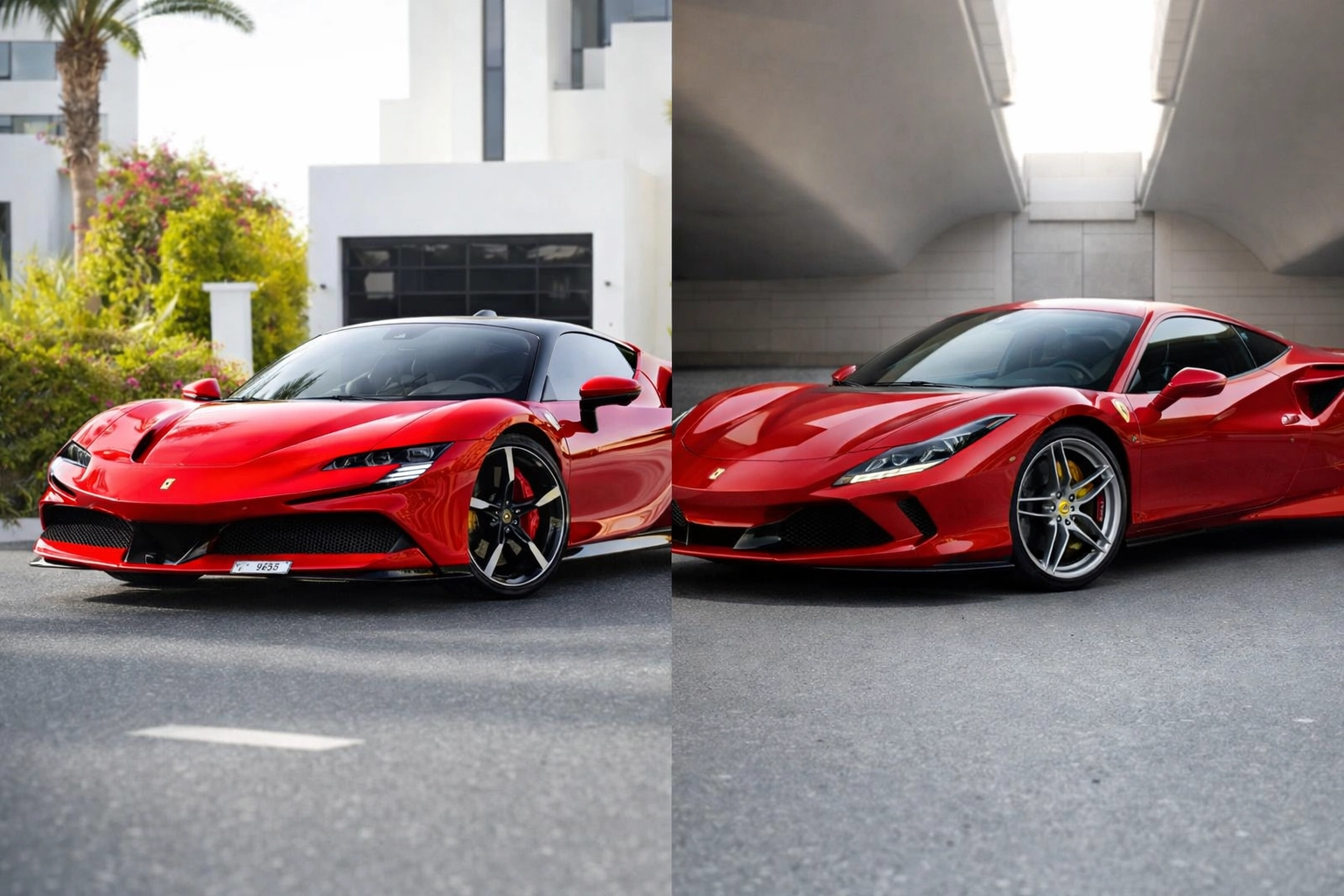

Decide whether you want raw, high-revving V8 drama or cutting-edge hybrid thrust—this piece compares the F8 Tributo’s traditional performance focus with the SF90 Stradale’s electrified powertrain so you can quickly see which aligns with your driving priorities.
If you want pure, visceral V8 response and lighter weight balance, the F8 Tributo delivers; if you want maximum combined power, instant electric torque, and hybrid tech that redefines daily usability, the SF90 Stradale is the choice.
You’ll get focused comparisons of straight-line numbers, chassis and handling tech, design trade-offs, interior experience, ownership realities, and why each car appeals differently to enthusiasts and collectors.
Follow the breakdown to match concrete performance and practical details to what matters most for your next Ferrari.
Overview of the Ferrari F8 Tributo and SF90 Stradale
Both cars put Ferrari performance first, but they take different technical routes: the F8 uses a high-revving twin-turbo V8 focused on raw response and lightness, while the SF90 combines a twin-turbo V8 with three electric motors for boosted power, instant torque, and partial electric driving.
Ferrari F8 Tributo Key Features
You get a 3.9‑liter twin‑turbo V8 tuned for sharp throttle response and a high redline, producing strong peak power with an emphasis on driver feedback. The F8’s chassis prioritizes low weight and mechanical balance; it uses conventional rear-wheel drive and a transverse engine layout to keep handling direct.
Aerodynamics are purposeful: the S‑duct front intake, refined rear diffuser, and compact bodywork generate downforce without excessive drag. Interior focus stays driver-centric with tactile controls, analog-like engagement, and minimal hybrid complexity. If you value pure V8 character, immediate engine feel, and lighter curb weight, the F8 delivers those traits.
SF90 Stradale Hybrid Architecture
You experience a plug‑in hybrid system built around a 4.0‑liter twin‑turbo V8 plus three electric motors—two on the front axle and one integrated with the gearbox—creating all-wheel drive when needed. Combined system output dramatically exceeds the V8’s solo figures, and electric torque fills low‑end response, cutting 0–62 mph times and improving in-gear acceleration.
The battery pack and electric motors enable pure-electric driving at low speeds, regenerative braking, and torque vectoring through the front motors for stability and turn-in precision. Packaging trades some lightness for complexity and added weight, but you gain hybrid-specific drive modes, selectable EV range, and a measurable jump in straight-line performance.
Distinct Identities and Market Positioning
You’ll notice Ferrari positions the F8 as the V8 purist’s sportscar: lighter, simpler, and focused on analogue driving thrills. Pricing and trim choices reflect a traditional supercar buyer who prioritizes immediacy and mechanical connection over electrified systems.
The SF90 targets buyers chasing maximum performance and technological leadership. It sits above the F8 in power and price, showcasing Ferrari’s hybrid strategy and performance ceiling with advanced electronics and multi-mode driving. Your choice depends on whether you prefer raw V8 engagement or hybrid-enhanced performance with electric functionality.
Performance Comparison
Both cars deliver extreme performance but via different approaches: the F8 Tributo uses a high-revving twin-turbo V8 focused on pure internal-combustion response, while the SF90 Stradale pairs a turbo V8 with three electric motors to boost power, torque delivery, and launch capability.
Engine Specifications
The F8 Tributo uses a 3.9-liter twin-turbocharged V8 that produces around 710 PS (approx. 700 hp) and strong mid-range torque. Its layout emphasizes mechanical immediacy and a high redline, so you feel direct throttle response and linear power as RPMs climb.
The SF90 Stradale combines a 4.0-liter twin-turbo V8 with three electric motors for a combined output near 1,000 PS (roughly 986 hp). Two motors drive the front axle for torque vectoring; one sits between engine and gearbox to fill torque gaps and assist shifts. The hybrid system gives instant electric torque and configurable power delivery for different driving modes.
You should note weight differences: the SF90 carries battery and electric hardware, increasing mass but offsetting it with vastly higher peak power and improved traction from all-wheel-drive capability.
0-100 km/h Acceleration Times
Expect the F8 Tributo to sprint from 0–100 km/h in the low 2.8–3.0 second range under optimal conditions. Its rear-wheel-drive setup and high specific power make for rapid launches, but traction relies on tire grip and driver technique.
The SF90 Stradale typically achieves 0–100 km/h in about 2.5 seconds or slightly under when using launch control. Electric torque from the front motors minimizes wheelspin and delivers a more repeatable, higher-traction launch, especially on imperfect surfaces.
If you prioritize raw launch numbers and consistency, the SF90 has the edge. If you value a traditional, visceral acceleration experience with rear-drive dynamics, the F8 still delivers exceptional performance.
Top Speed Assessment
The F8 Tributo’s top speed is around 340 km/h (211 mph). Its aerodynamics, gearing, and engine characteristics target high-speed stability while preserving responsive handling at lower speeds.
The SF90 Stradale’s top speed is slightly higher, rated around 340–350 km/h (211–217 mph) depending on configuration and conditions. The hybrid powertrain provides sustained high-speed shove, and aerodynamic tuning supports stability at those velocities.
Top-speed figures are close between the two, so your choice should hinge more on how you want to access that speed—mechanical, rev-driven power in the F8, or immediate, hybrid-assisted surge in the SF90.
Driving Dynamics
The F8 offers a compact, lithe feel with rear-wheel-drive balance, sharp steering, and a focus on driver feedback. You’ll notice chassis purity: weight distribution and suspension tune favor agility, making it lively through mid-speed corners.
The SF90 brings all-wheel-drive traction, advanced torque vectoring, and selectable hybrid modes that change character dramatically. In electric-assisted modes you get instant turn-in and grip from the front motors; in full-hybrid or dynamic modes you access near-supercar levels of lateral performance with more understeer control available when needed.
You should expect the F8 to reward precise, committed inputs and provide more conventional supercar engagement. The SF90 rewards strategic use of its systems, delivering superior grip and repeatability, especially when launching or exiting tight corners.
Hybrid Power vs Traditional Powertrains
You’ll see how a plug-in hybrid system changes fuel use, weight distribution, and on-demand power compared with a high-revving twin-turbo V8. Expect trade-offs between usable electric range, complexity, and raw mechanical responsiveness.
Hybrid Efficiency and Benefits
You gain measurable fuel savings in city and mixed driving with the SF90’s PHEV layout compared with the F8’s pure V8. The SF90 pairs a 4.0L twin-turbo V8 with three electric motors and a battery pack, which lowers gasoline consumption during low-speed or stop-and-go driving and reduces short-trip fuel costs.
You also get regeneration during braking that recovers energy you would otherwise lose. That improves real-world efficiency and reduces wear on the mechanical brakes.
On the downside, the hybrid system adds weight and packaging complexity. That extra mass affects steering feel and lateral dynamics unless engineers compensate with suspension tuning and chassis reinforcement. You should weigh everyday economy gains against slightly altered handling characteristics during spirited driving.
Battery Technology and Electric Range
The SF90 uses a high-voltage lithium‑ion battery designed for performance-oriented duty cycles rather than long commuter ranges. Typical pure-electric range is short—generally just a few dozen kilometers—so you’ll mostly use electric drive for short urban trips and launch maneuvers.
Battery placement behind the cockpit helps lower the center of gravity, aiding balance compared with a front-biased layout. Thermal management and robust cooling keep the battery and motors within optimal temperature windows during repeated hard runs.
You’ll need to consider charging convenience. Home charging overnight or top-ups at public chargers maximize the SF90’s electric-use benefits. If you rarely charge, the battery still assists performance, but you’ll get fewer fuel-economy advantages.
Instant Torque Delivery
Electric motors give you immediate torque from zero rpm, which changes how the car accelerates off the line. The SF90’s motors supply instant thrust to the front axle (and an electric boost to the rear), so low-speed punch and multi-stage acceleration feel faster and more linear than the F8’s turbocharged V8.
The F8 relies on a high-revving torque curve and rapid turbo response to produce 711 bhp from its 3.9L V8. That delivers a visceral, continuous drive experience that rewards throttle modulation and gear selection.
You should note differences in feedback. The SF90’s blended torque can mask some mechanical cues you expect from a traditional engine, while the F8’s naturally mechanical delivery gives clearer driver connection during high-rpm work. Choose based on whether you prioritize immediate off-the-line thrust or analog, high-rev sports-car engagement.
Chassis and Handling Technologies
Both cars use stiff, lightweight structures and advanced aerodynamics to sharpen turn-in, increase grip, and control load transfer. You get precise steering feel from mechanical geometry and electronic aids calibrated for each model’s power delivery and weight.
Weight Distribution and Balance
The F8 Tributo centers mass around a rear-mid V8, achieving a near 44/56 front/rear bias that emphasizes rear traction and lively turn-in. You’ll feel a more traditional, rear-driven balance: the back-end offers progressive bite under throttle and a direct response when you rotate the wheel.
The SF90 Stradale shifts balance rearward further because of its PHEV layout and battery pack placement. With electric motors up front and a heavy battery low in the chassis, your effective weight distribution is closer to neutral under many conditions, but overall mass increases. That extra weight changes inertia: you gain stability at high speed and under braking, while low-speed direction changes require more commitment.
Both cars use weight placement to tune behavior: F8 for agility and immediacy, SF90 for high-speed composure and hybrid-assisted traction. You must account for the SF90’s higher curb weight when judging responsiveness and braking distances.
Suspension Systems
The F8 uses a double-wishbone front and multi-link rear setup with magnetorheological dampers and high-rate anti-roll bars. You get crisp body control and quick transient response, and the damping map changes firmness nearly instantly to preserve mechanical grip on bumpy surfaces.
The SF90 combines similar architecture with recalibrated dampers and stronger bushings to support the battery mass. Active damping works with torque-vectoring and four-wheel drive electronics to manage pitch and roll while blending electric motor torque for corner exit.
Key differences for you to note:
- F8: lighter unsprung mass, sharper feedback, prioritizes driver feel.
- SF90: adaptive systems tuned for stability, integrates traction from front electric motors.
Both permit selectable modes (Comfort/Sport/Track) that change damping rates, steering assist, and electronic limits so you can tailor balance and ride to road or track conditions.
Design and Aerodynamics
Both cars prioritize downforce and cooling, but they take different approaches: the F8 uses sculpted, traditional Ferrari coupe lines with integrated aero channels, while the SF90 combines sharp, modern surfaces with active elements to manage airflow for hybrid cooling and electric packaging.
Exterior Styling Differences
You’ll notice the F8 Tributo keeps a classic mid‑rear engine silhouette with flowing hips and L‑shaped lighting cues. Its front end uses a pronounced S‑duct integrated into the bonnet and larger side intakes for brake and intercooler cooling, emphasizing function in a cohesive, sculpted package.
The SF90 Stradale presents a more angular, futuristic face and a wider track to accommodate extra hardware. Headlights sit lower and horizontal, and the tail adopts squared elements to house cooling ducts and diffusers linked to the hybrid layout. Proportions shift forward slightly to make room for the battery and inverter mass, which changes visual balance compared with the F8.
Key visual differences at a glance:
- F8: smoother curves, traditional Ferrari cues, concentrated mid‑engine packaging.
- SF90: sharper lines, broader stance, visible vents and cooling outlets related to hybrid systems.
Aerodynamic Innovations
You’ll find the F8’s aero focuses on passive shaping: the S‑duct increases front downforce without moving parts, while underbody channels and a rear diffuser extract air cleanly to stabilize high‑speed balance. The result prioritizes predictable handling and lightweight efficiency.
The SF90 adds active aerodynamics and directed cooling for its hybrid systems. It uses movable flaps, an active rear wing and venting that adapts to braking, torque delivery, and battery temperature. These elements let the SF90 vary downforce dynamically—improving cornering when needed and reducing drag on straights—while routing airflow to radiators and the electric motor inverter to maintain performance under sustained load.
Notable aero features compared:
- F8: S‑duct, optimized undertray, fixed rear diffuser.
- SF90: active wing/flaps, adaptive cooling ducts, vented rear deck tied to hybrid thermal management.
Interior Features and Driver Experience
Expect a driver-focused layout with high-quality materials and different priorities: the F8 emphasizes analog engagement and tactile controls, while the SF90 packs hybrid-specific displays and more electronic aids. Both put you close to the road, but they do it with different mixes of mechanical feedback and digital information.
Cockpit and Controls
The F8 places traditional driving controls directly under your hands. The steering wheel keeps essential buttons and the manettino switch; the instrument cluster is centered on an analog tachometer with a small digital screen for trip and performance data. You get limited central touchscreen use to reduce distraction, keeping HVAC and clear physical switches within reach.
The SF90 shifts more input to digital interfaces while retaining a race-oriented steering wheel. It adds a larger central screen and multiple hybrid-status readouts, including battery charge, torque distribution, and EV range. You still have steering-wheel controls for drive modes, but expect more menus and configurable displays when you want telemetry or energy management information.
Comfort and Technology Integration
Seats in both cars support aggressive lateral containment for spirited driving, but differ in adjustability and trim options. The F8 offers sport seats with premium leather or Alcantara and straightforward electric adjustments; emphasis stays on weight savings and driver contact rather than plush amenities.
The SF90 provides more tech-driven comfort options linked to its hybrid systems. Climate control, infotainment, and driver assistance features integrate with the larger touchscreen and secondary displays. You can monitor hybrid-specific settings—regenerative braking levels and EV-only range—directly from the cabin. Sound insulation is higher in the SF90 to mask electric drive noises when cruising, while the F8 keeps engine sound prominent as part of the experience.
Ownership and Practical Considerations
Owning either the F8 Tributo or SF90 Stradale means balancing performance, routine service, and daily usability. Expect differences in maintenance schedule, fuel use, insurance, and resale dynamics driven by the SF90’s hybrid systems and the F8’s pure V8 simplicity.
Reliability and Maintenance
You should plan for Ferrari-level servicing intervals: major inspections typically every 12 months or ~10,000–15,000 miles depending on use. The F8’s twin-turbo V8 has fewer high-voltage components, so its service needs focus on engine, turbochargers, and gearbox wear.
The SF90 adds high-voltage batteries, three electric motors, inverters, and regen systems. Those components require specialized diagnostics and occasional high-voltage service that only trained technicians should perform. Battery health checks and software updates are part of normal upkeep for the SF90.
Warranty coverage and authorized-service availability affect reliability experience. Factor in travel to a Maranello-trained dealer if you live far from a major service center. Keep detailed service records to protect resale value for either car.
Running Costs
Expect higher baseline running costs than premium road cars. For the F8, budget for premium fuel, frequent brake-pad and tyre replacement due to high-performance setup, and periodic clutch or transmission service if driven hard.
The SF90 uses electricity to reduce fuel consumption in urban or short trips, but its total cost can be higher. High-voltage component repairs and battery replacement (long-term) carry steep price tags. Insurance premiums are typically higher for the SF90 because of replacement cost and repair complexity.
Common cost items for both:
- Fuel: premium gasoline; SF90 reduces pump visits only in EV mode
- Tyres: high-grip, low-lifespan summer tyres
- Brakes: wear varies with driving; carbon-ceramic options reduce frequency but raise replacement cost
- Insurance and depreciation: both strong factors; limited production and desirability can help residuals
Plan annual ownership costs in the tens of thousands of dollars when you include insurance, service, tyres, and unexpected repairs.
Market Impact and Enthusiast Appeal
You’ll notice the F8 Tributo serves traditionalists who value a high-revving V8, analogue feedback, and relatively lower complexity. Its market position keeps resale values strong among collectors who prefer purity of driving experience and easier maintenance.
The SF90 Stradale targets buyers drawn to cutting-edge hybrid performance and technological novelty. You get blistering acceleration and advanced systems, but you should expect higher acquisition costs and potentially more complex long-term service considerations.
Enthusiast communities split along clear lines. Some purists champion the F8 for its mechanical honesty and emotive soundtrack. Others celebrate the SF90 for expanding what a Ferrari can do, attracting tech-focused buyers and new customers to the brand.
Key market effects:
- F8 Tributo: steadier values, strong demand from collectors, lower ownership complexity.
- SF90 Stradale: halo-model status, pushes Ferrari into electrified supercar segment, attracts early adopters.
You should consider how each model influences Ferrari’s brand image. The F8 reinforces heritage and driving tradition. The SF90 signals a shift toward hybrid performance, widening Ferrari’s customer base and future product expectations.
If you follow resale and forum trends, you’ll see different owner priorities reflected in pricing, maintenance discussions, and aftermarket interest. Both models keep Ferrari culturally relevant but appeal to distinct buyer profiles.
Conclusion
You will choose the F8 Tributo if you prioritize pure, naturally aspirated-style V8 driving feel and a lighter, more analog connection to the road. It rewards driver inputs with sharp responses, excellent balance, and a traditional mid-engined sports-car character.
You will choose the SF90 Stradale if you want maximum straight-line performance, cutting-edge hybrid propulsion, and advanced electronic aids that expand usable performance. It delivers far greater power and efficiency through its plug-in hybrid system while altering the driving experience toward precision and technological orchestration.
Consider these practical differences when deciding:
- F8 Tributo: lighter curb weight, simpler powertrain, more direct mechanical feedback.
- SF90 Stradale: higher peak power, electric assist, selectable EV modes, and superior lap pace potential under certain conditions.
Your budget, intended use, and appetite for complexity should guide the choice. If you prefer a visceral, driver-focused car for weekends and twisty roads, the F8 aligns well. If you want the fastest possible Ferrari road car with hybrid tech and multiple driving personalities, the SF90 fits better.
Weigh trade-offs between mechanical purity and technological performance. Either way, you get a high-performance Ferrari tailored to different definitions of speed and engagement.
Frequently Asked Questions
What are the primary performance differences between the F8 Tributo and the SF90 Stradale?
The F8 Tributo relies on a 3.9‑liter twin‑turbo V8 that emphasizes instantaneous throttle response and a linear powerband. It delivers strong, traditional supercar feel through an internal‑combustion‑driven chassis.
The SF90 Stradale combines a twin‑turbo V8 with three electric motors for a total system output substantially higher than the F8. That hybrid setup yields greater peak power, selectable pure‑electric driving, and multiple drive modes that alter power distribution and traction.
How does the hybrid system in the SF90 Stradale enhance its driving experience compared to the F8 Tributo?
The SF90’s electric motors provide immediate torque at low speeds, improving off‑the‑line responsiveness and fill‑in under boost. You also get selectable e‑drive modes for quiet electric propulsion, hybrid efficiency, or full‑power performance.
Regenerative braking and torque vectoring from the electric motors improve traction and cornering control in ways a purely mechanical drivetrain cannot. Those systems can make launches and midcorner exits quicker and more composed than in the F8.
What are the 0-60 mph acceleration times for both the F8 Tributo and the SF90 Stradale?
The F8 Tributo typically achieves 0–60 mph in the mid‑2‑second range to low‑3s depending on conditions and specification. Expect times around 2.9–3.0 seconds for well‑equipped examples under ideal conditions.
The SF90 Stradale is faster, commonly recording 0–60 mph in roughly 2.5 seconds or slightly below in optimal conditions. Its electric assist and higher combined output account for the quicker launches.
Can the SF90 Stradale’s electric motors significantly improve fuel efficiency over the F8 Tributo?
Yes, in everyday driving the SF90 can show noticeably better fuel figures when you use its electric or hybrid modes often. Short commutes and city driving can exploit electric propulsion and regenerative braking to reduce fuel consumption versus the pure‑ICE F8.
On spirited runs or track use you’ll see the SF90’s efficiency advantage shrink because the electric system supplements performance rather than conserving fuel. Real‑world gains depend heavily on driving patterns and how frequently you operate in electric or hybrid modes.
How does the handling of the Ferrari F8 Tributo compare to that of the SF90 Stradale?
The F8 offers direct steering feel, lighter front-end sensation, and a chassis tuned around a combustion‑engine balance that rewards precise driver inputs. It feels more traditionally connected and predictable at the limit for drivers who prioritize mechanical feedback.
The SF90 adds complexity with front electric drive and advanced torque vectoring, which enhances front traction and corner exit grip. That tech can make the SF90 faster through certain corners, but it also creates a different steering and weight sensation compared with the F8.
What are the price differences between the Ferrari F8 Tributo and the SF90 Stradale?
The SF90 Stradale carries a premium over the F8 Tributo due to its hybrid systems and higher performance. Base pricing differences vary by market and options, but expect the SF90 to start substantially higher than the F8.
Options, taxes, and dealer pricing can widen that gap further, so final purchase prices often depend more on spec and region than factory base figures.
0 Comment